
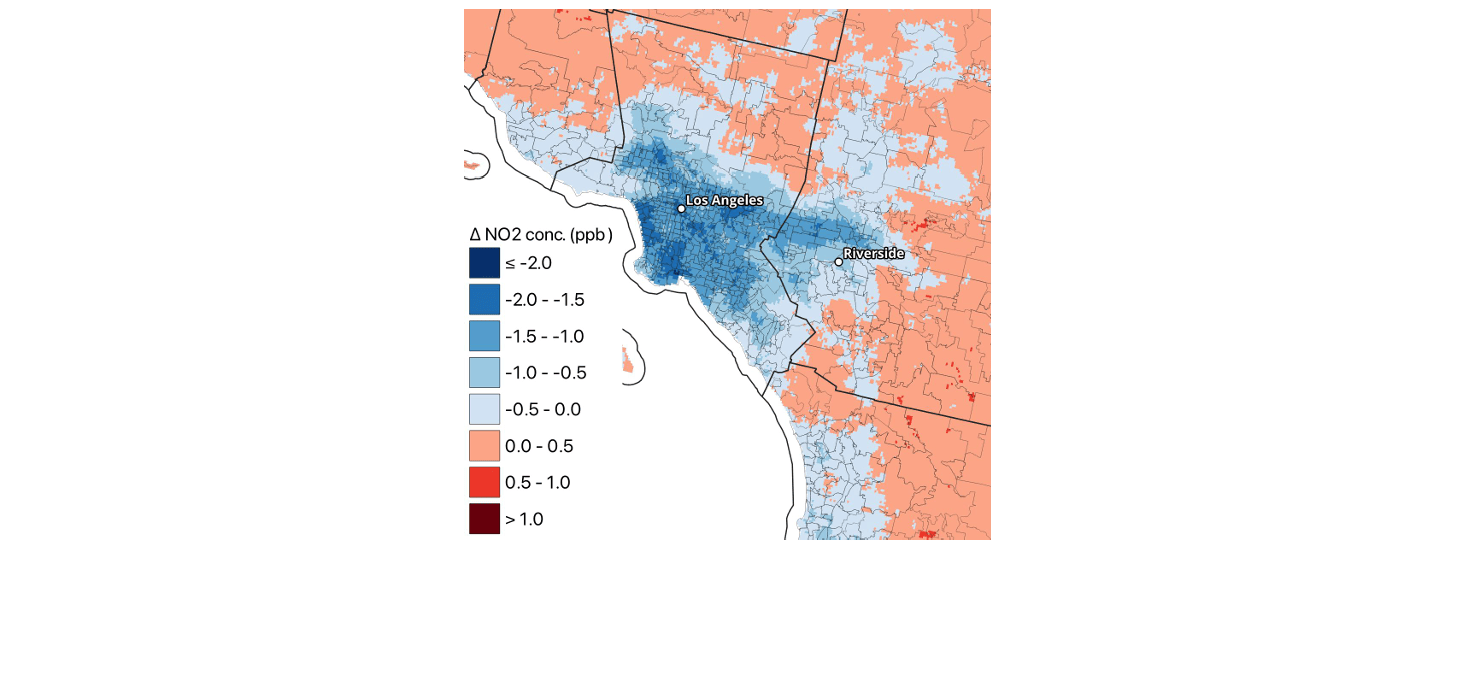
Above: Telework dramatically reduced toxic NO2 over U.S. urban areas in 2025, with the greatest reductions over Southern California. RTO mandates may now be reversing the trend, however.
By Erik Skindrud, InfoWise.org
A team from Stanford, Columbia, UC San Diego and Basel, Switzerland has found “large and persistent reductions” in toxic smog as a result of telework trends in major U.S. urban areas.
The highest reductions in nitrogen dioxide, or NO2, levels took place over Southern California. The Los Angeles result saw NO2 drop by an average of 1.17 parts per billion — a reduction that corresponds to an expected drop of approximately 360 deaths each year.
The New York City area saw a drop of .81 ppb, and the Chicago area a drop of .46 ppb — with annual lives saved of 420 and 120, correspondingly. (New York’s estimated averted deaths exceed L.A.’s due to its higher total population.)
The number of lives saved by teleworking across the U.S. is likely much higher. Fatalities now may be increasing, unfortunately. Smog improvements were based on 2025 data — before return-to-office mandates like the California governor’s 2026 RTO dictate took place.
“We estimate that lower NO2 concentrations in 2025 relative to 2019 are associated with approximately 1,500 to 3,500 fewer annual deaths across U.S. metropolitan areas,” the smog study authors conclude.
The study’s lead author is Stanford University economics professor Nick Bloom, listed as a “LinkedIn Top Voice In Remote Work” on the Microsoft jobs platform.
“The rise in WFH has also substantially reduced commuting, especially into city centers, where employment is concentrated in industries with high WFH rates, including finance, information, and professional services,” the authors note.
“The broader message is that WFH has environmental consequences as well as workplace consequences,” study authors add. “Discussions of WFH often focus on productivity, worker well-being, downtown commercial real estate, public transit, and the future of cities. Our results suggest that air quality and health should also be part of this debate.
Study data consists of monthly NO2 levels recorded by European Space Agency’s Copernicus Sentinel satellites.
The team’s findings were presented at the 2026 Stanford Remote Work Conference on Oct. 29 in Palo Alto. Findings are preliminary, and subject to peer review before final publication.
The pre-publication paper is available for download here.
Erik Skindrud is a writer in Huntington Beach. @Erik_Bookman on X.

