

Above: A Tehran-based teacher worked on her laptop before the war erupted in February 2026. Iran government workers are now logging in from home as well — part of a plan to conserve fuel and energy. Photo: Majid Asgaripour / West Asia News Agency
By Erik Skindrud, InfoWise.org
The ongoing Middle East conflict is accelerating the global telework movement as governments move to conserve petroleum and protect employees in risk zones. The result is a surge in work-from-home from Jeddah to Jakarta — as the war succeeds COVID-19 as a telework driver.
In another development, the government of U.K. Prime Minister is making telework rights a key component of its national policy — showing that a pro-telework stance in a large Western nation does not always generate crippling backlash from its business community.
Meanwhile California, which birthed the telework idea in the 1970s, now clings to a reactionary government policy that hobbles climate action, pollution policy, reduced traffic congestion, and a host of other aims — in the name of a rebranding for its ambitious governor.
Ironically, other leaders, who lobbed bombs at each other a short time ago, now find themselves in agreement. Telework works — Saudi Arabia, Iran, Vietnam, the Philippines, the U.S. military, and others concur.
Brent crude futures touched $117 per barrel on Oct. 23. Iranian attacks on Hormuz traffic and rhetoric from the sitting U.S. President share blame. Pumped-up price raises the specter of $7-a-gallon gas in California — where the global affordability crisis pinches consumers painfully.
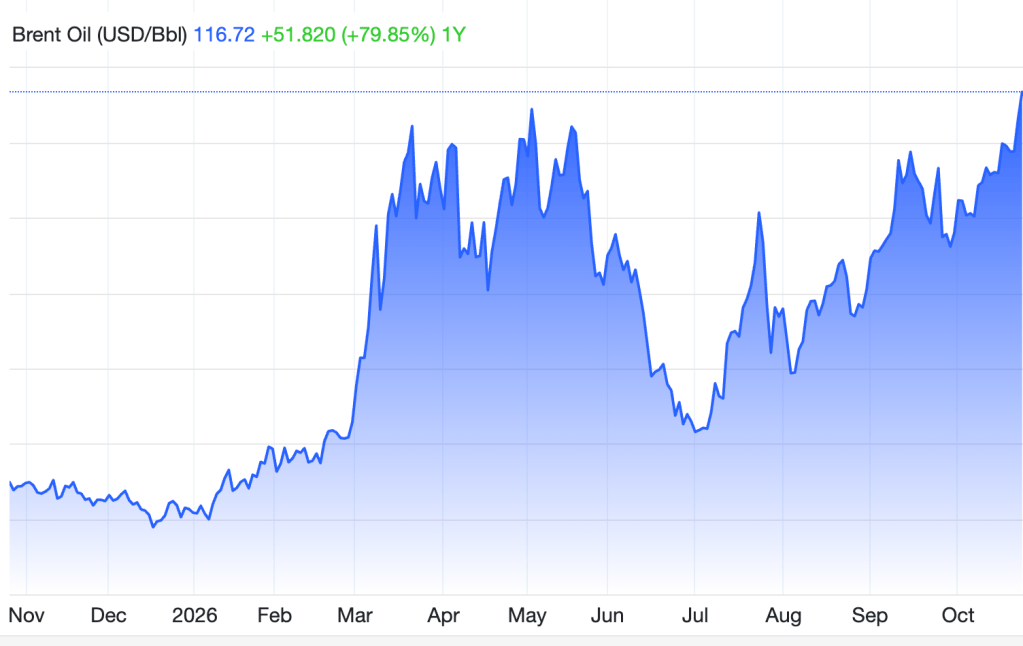
Brent crude futures touched $117 a barrel on Oct. 23 — with the prospect of per-gallon California rates exceeding $7 a gallon if new attacks on Iran materialize. Image: https://tradingeconomics.com/commodity/brent-crude-oil
In April, Paris-based International Energy Agency named “working from home remotely” as a strategy governments can easily implement to conserve gas and diesel. The IAE estimated that three remote days a week — for office workers — reduces a nation’s fuel consumption by two to six percent.
Re-implementing telework for one million U.S. federal workers would nudge gas prices down, and relieve pressure on taxpayers, writes Justin Chen, whose organization represents Environmental Protection Agency employees.
This “kind of practical action is exactly what is needed,” Chen argued in The Hill in April. “So what is holding the Trump administration back?”
The answer is simple, and applies to the California governor too — politics — and politics only.
A growing number of governments are taking logic to heart — a review of responses to the so-called Iran War shows. Below is a summary of global telework policies implemented since February’s launch of hostilities.
The below press excerpts are condensed and include light editing.

Above: Saudi Arabia’s Aramco petroleum conglomerate is headquartered on a corporate campus in Dhahran. The executive office building, in red above, suffered “extensive damage” on Oct. 13 when it was hit by a ballistic missile. Photo: www.aramco.com/en/about-us/our-offices-and-facilities
SAUDI ARABIA: “Oil giant Saudi Aramco’s headquarters in Dhahran suffered extensive damage in an attack on Oct. 13, with a fire spreading across several floors. Employees were then directed to work from home, according to a Reuters report. A fire started on the ninth floor of the south wing of the office block, and spread between the sixth and 10th floors. Another source added that the top three floors of building, where the office of Aramco CEO Amin Nasser is located, were severely damaged, with part of the ceiling caved in and windows and doors blown out. More recently, Saudi students were directed to hold classes online due to drone and missile attacks.”
IRAN: “President Masoud Pezeshkian signed a directive on September 12 instructing government agencies to facilitate remote work for suitable employees to save on petrol, electricity and natural gas costs for the state. ‘We have begun consumption savings with the government,’ Pezeshkian said, according to an Aljazeera report. This is seen as effectively framing remote work and other measures for government workers as in line with other energy-saving measures that the government has asked of the rest of the population.”
MULTIPLE COUNTRIES: “Worldwide, at least 12 countries have stepped up remote work or scaled back the workweek in response to the energy crisis, according to the International Energy Agency via an April Yale University news report. Several Asian countries, which are heavily reliant on oil shipped through the Strait of Hormuz, are leading the push. Thailand and Vietnam are encouraging remote work, while Sri Lanka, Indonesia, Malaysia, Myanmar, and Laos are mandating it for public employees. Pakistan and the Philippines are going a step further, shortening the workweek for public officials to just four days.”
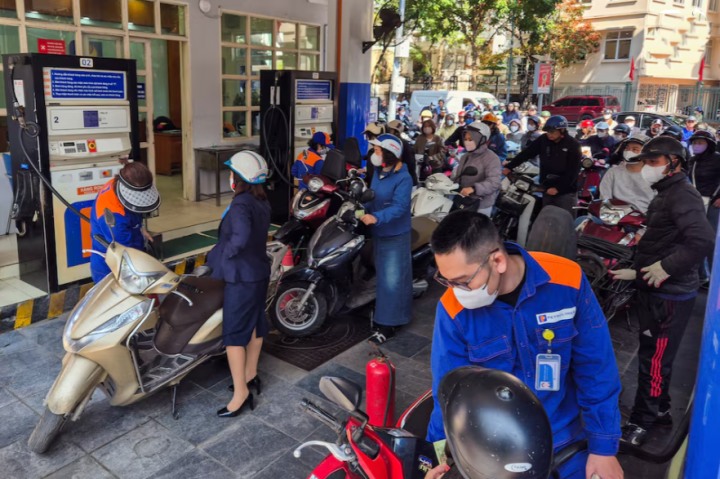
Commuters queue at a Vietnam gas station in March. Around this time, the country’s trade ministry called on employees to work from home to save fuel — amid supply disruptions triggered by the U.S.-Israeli attacks on Iran. Photo: Khanh Vu / Reuters
BAHRAIN: “Bahrain (in June) said it was activating remote work in ministries and government agencies at a rate of 70%, effective immediately, following U.S. attacks on Iranian nuclear sites, the Wall Street Journal reported. The tiny island nation in the Persian Gulf is home to a large U.S. military base and has normalized relations with Israel. This order excludes staff responsible for emergency situations and public safety, the Bahrain Civil Service Bureau said.”
U.K.: Prime Minister Andy Burnham’s government is overseeing a dramatic shift to telework. His government proposes sweeping reforms as part of the Employment Rights Act, slated to take effect in 2027. These rules will make it harder for employers to issue RTO mandates or reject hybrid and remote working requests without heavily-justified, case-by-case rationales. Burnham has not linked the policy shift to the Iran war or rising energy costs. The government has framed the shift as a crucial step toward worker retention, supporting caregivers, and workplace efficiency.
U.S. MILITARY: “Iran has bombed U.S. bases across the Middle East in retaliation for the U.S.-Israeli war, forcing many American troops to relocate to hotels and office spaces throughout the region,” the New York Times reported on March 25. “So now much of the land-based military is, in essence, fighting the war while working remotely. Iranian officials have accused the U.S. military of using civilians as human shields by putting American troops in hotels. The lack of better planning, some military officials said, also reflects a miscalculation on the part of the administration about how Iran would respond.”
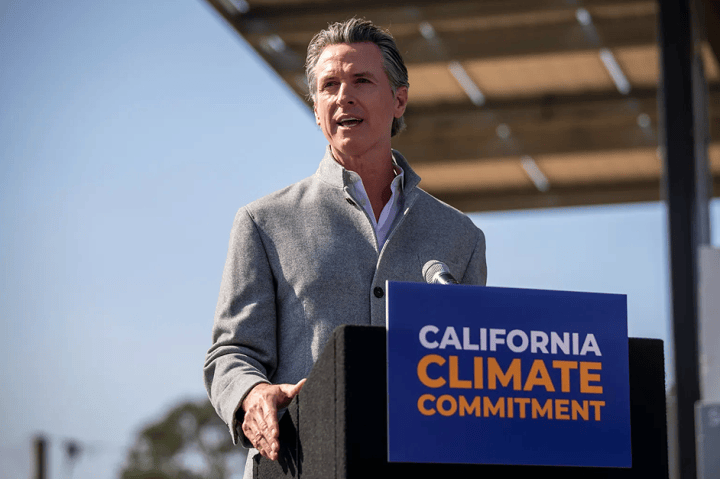
Above: California Gov. Gavin Newsom now sees his history of climate and pro-environment advocacy as a liability that may limit his appeal in a run for U.S. President. Above at Vallejo, Calif. in 2022. Photo: Martin do Nascimento / CalMatters
CALIFORNIA: Gov. Newsom has made his stance on telework clear with multiple statements and gestures blocking its implementation. In September, he vetoed a bill that would have required departments to provide written justifications when requiring employees to work in the office.
Multiple commentators, including veteran Sacramento columnist Dan Walters, William Melhado of the Sacramento Bee, and a state employee, see Newsom’s presidential ambition as driving his RTO policy.
With just over two months left in his term, the governor has little incentive to weigh in on labor battles, Wesley Hussey, a political science professor at Sacramento State, told Sacramento PBS station KVIE on Oct. 22.
“I don’t think there’s any benefit for Newsom to respond,” Hussey said. “If he’s termed out, he doesn’t want to have conflicts with unions.”
Likely incoming governor Xavier Becerra has weighed in on telework in the past. ‘What should drive state policy on Return to Office is the goal of ensuring the highest performance, productivity and resilience of our state workers,’ Becerra said in March.
If Newsom punts a deal with SEIU 1000 to the next governor, action may not come immediately, Hussey explained.
“The first year of the new governor is really the previous governor’s budget,” Hussey said. “But by the May revise, there is a little bit more of the personality of the new governor.”
Erik Skindrud is a writer in Huntington Beach. @Erik_Bookman on X.

