
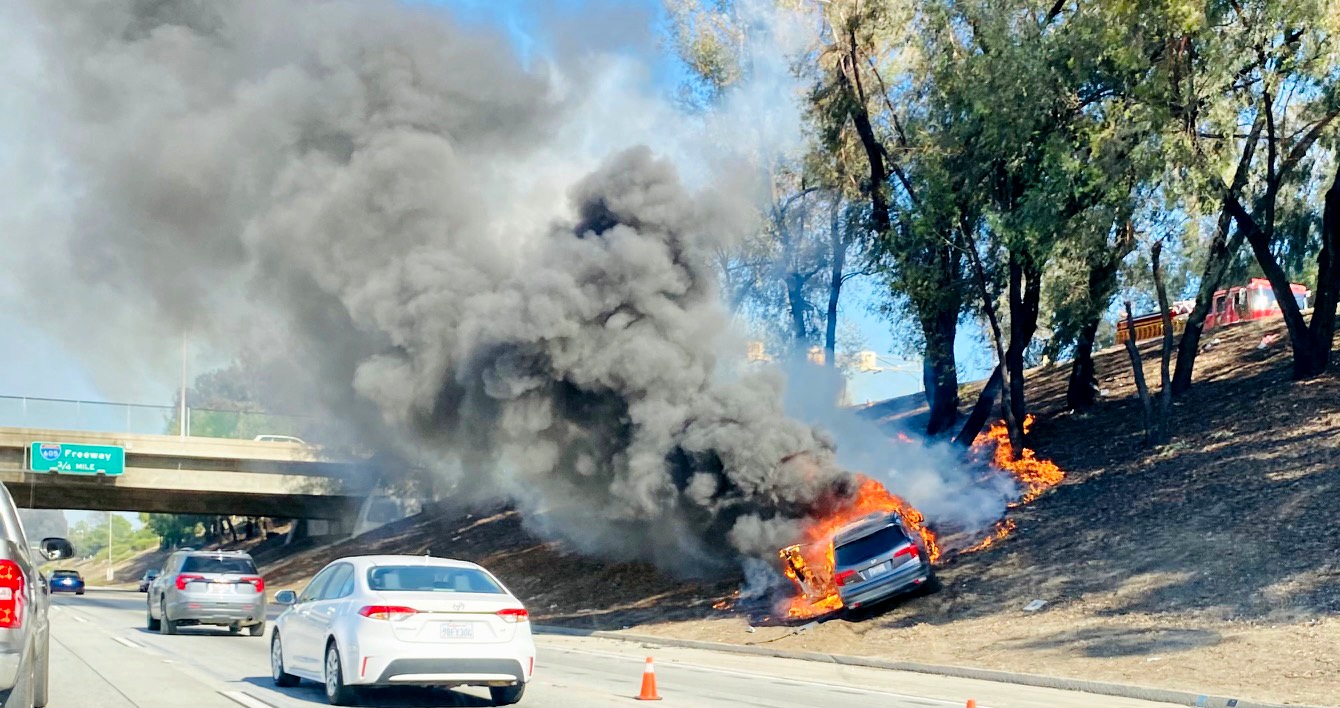
Above: A Honda SUV burns along the eastbound I-105 freeway in April 2024. Calculations suggest close to three travelers might die in vehicle wrecks annually in connection with California’s doubling of in-office days for state employees. Photo: Erik Skindrud, InfoWise.org
By Erik Skindrud, InfoWise.org
A motorist’s head is on the chopping block each time she or he straps into an automobile. It’s a fact — though few think about it.
This idea intrudes, as my 60-mile-per-day commute to downtown Los Angeles doubled to four days a week under Gov. Gavin Newsom’s return-to-office order. By simple logic, his July 2026 command doubled my chance of dying a violent traffic-collision death while commuting.
But can we quantify the risk? How many victims might be added to death roles each year under this RTO — given published statistics? Let’s crunch the numbers.
Our calculation is N * C * D * D-r / 100 million = average number of annual fatalities added by RTO.
In this formula, N stands for the number of state workers commuting by personal vehicle, C is California’s average per-day commute distance, D is the number of added days commuting per year under RTO, D-r is the state’s death rate per 100 million miles traveled. This product is then divided by 100 million to yield the expected average number of fatalities added by the governor’s RTO annually.
Plugging in numbers gives the following. Note live links to published statistics.
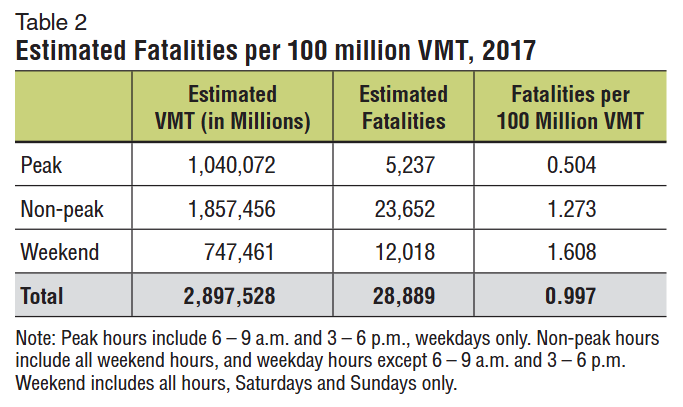
N (90,250) * C (32 miles) * D (100 days added by Newsom / year) * D-r (1.26 per 100 million miles traveled) / 100 million = 3.64 added fatalities under RTO per year.
The number of estimated fatalities includes other motorists or passengers, cyclists and pedestrians, not just state-worker drivers. Statistics suggest the majority will be the drivers, however.
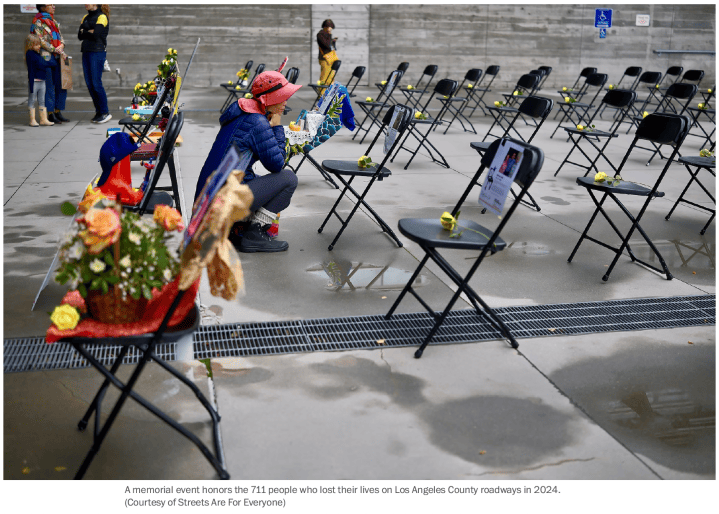
Above: Volunteers placed chairs at the Department of Transportation plaza in Los Angeles and at a nearby Los Angeles Police Department facility for a World Day of Remembrance Event in 2025. “We wanted to hold part of it at L.A. City Hall but couldn’t get the permits,” L.A.-based Streets Are For Everyone, or SAFE founder Damien Kevitt told InfoWise.org. “Since we were working with the California Office of Traffic Safety on the event, they helped to get Caltrans to grant the permits to hold it there.” Kevitt was struck by a car and dragged underneath in Griffith Park in 2013 — resulting in the loss of a leg. Image: Washington Post / Streets Are For Everyone
Factors that contribute to increased risk on the road are diverse and debated by traffic-safety and other professionals and academics. One 2016 study, for example, found for each one-percent increase in U.S. unemployment figures, close to 5,000 fewer motorists succumb in collisions each year. The study attributes risk to a higher proportion of older drivers on the road during economic good times. Another paper, also published in 2016, points to more large commercial trucks on the road taking tolls during high-employment periods.
To be sure, uncertainty exists over theses estimates.
For my commute, speeds vary from 5 mph to 85 mph as I pass over two counties. Significant time exists where large noncommercial trucks irresponsibly weave between vehicles, likely elevating risk of fatal collisions.
Multiple studies find rates of nonfatal injury collisions are higher during peak hours — due to increased volume. However, the nationwide rate of nonfatal injury collisions per 100 million miles driven (74 in 2024) places an unfortunate number of traumatic wrecks on California state employee shoulders — and foreheads, elbows, and legs — during their RTO commute time. Running the numbers again, we see the governor’s RTO yielding close to 214 nonfatal injury accidents that would not have occurred during the two-days-in, three-days-from-home schedule.
The discussion shines light on an unsavory and neglected-by-media dynamic. In a stubborn and piggy manner, American motorists insist on their right to breeze at maximum speed toward their destinations. Politicians timorously retreat into turtle shells when voter ire is inflamed.
Since Sweden launched the international Vision Zero highway-safety initiative in 1997, fatality rates plunged across Europe, while trending up in the U.S. The sitting California governor has publicly endorsed safety — but in 2024 vetoed legislation prioritized by the Vision Zero community. The bill, SB 961 would have mandated speed-limit warning notifications in new vehicles. It would not have prevented motorists from accelerating over speed limits to pass vehicles — or to just ignore the law.
Gov. Newsom withheld his signature — apparently fearing future Sammy Hagars composing new variations on “I Can’t Drive 55.”
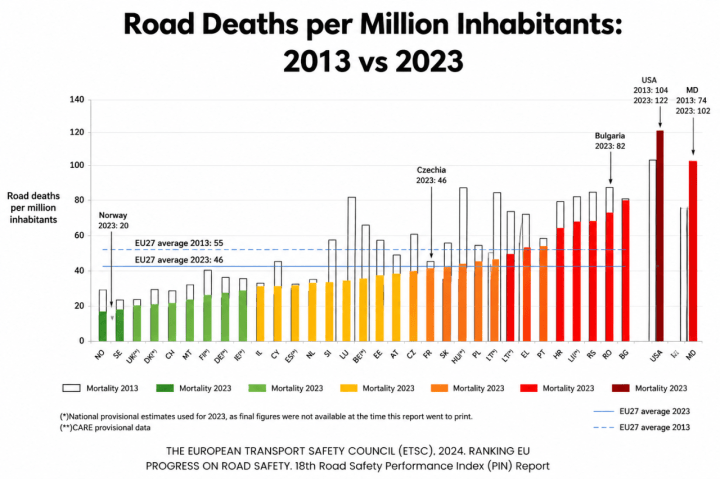
Above: Road fatality rates in the U.S. outstrip rates in the European Union. This EU graph shows the success of the Vision Zero initiative in Europe compared to its flop in the U.S. Libertarian impulses have pushed back repeatedly against legislation designed to curb U.S. speeding.
Newsom “should have led on this crisis, as Wisconsin did by passing the first seatbelt mandate in 1961,” SB 961 author Scott Weiner (D–San Francisco) stated. “Instead, this veto resigns California to a completely unnecessary risk of fatality.”
Several news outlets have focused on the timid-politician traffic fatality issue, a development that may raise pressure on them. Long pieces have run in the Washington Post, and CalMatters.
The lack of concern is a symptom of Americans’ unwillingness to prioritize life and limb over speed, convenience, and a sort of kindergarten “freedom.” Mask mandates are another example.
“We dismiss 40,000 deaths (annually) as the ‘cost of doing business,'” wrote MIT Professor of Cities and Transportation Jinhua Zhao in January.
Zhao sees a “choice of carnage” at work when politicians, traffic engineers, and the public knowingly, or through self-deception, allow policies that yield traffic collision death.
Research shows a rise of unemployment in the U.S. of just one percent can save 5,000 human lives and $8 billion in public and other expenses. These are numbers worth paying attention to.
Politicians should be nudged when research reveals measures that save thousands of lives. That also goes for measures that are new to motorists and voters.
“Policy implications may be to… implement telework programs or create different routes for commuters and commercial traffic,” suggests a 2017 paper on recessions and fatalities by University of Pennsylvania’s Monica King.
Decisions on in-office versus telework should consider lives saved in addition to productivity, congestion, employee mental health, caregiver support, gender equity and multiple other benefits of telework.
Erik Skindrud is a writer in Huntington Beach. @Erik_Bookman on X.
 InfoWise.org