

Above: “It’s not fair to shackle our office workers (as) bedrock for downtowns,” Assemblymember Alex Lee told lawmakers on June 17. Lee spoke at a state senate hearing on AB 1729 — which would undo the governor’s RTO plan by giving state agencies authority to set their own telework policies. Photo illustration: ChatGPT
By Erik Skindrud, InfoWise.org
The union that represents state legal workers used California’s CEQA environmental law in May to challenge the governor’s RTO mandate — which would double gas burned, carbon and particulate pollution, and commuter miles traveled for more than 90,000 state employees.
The complaint was delivered to more than 90 state departments, offices and agencies on May 27.
— SCROLL DOWN TO VIEW IMAGES —
“RTO policy may cause… adverse impact on air quality, climate, and human health due to increased automobile traffic and related tailpipe emissions,” states a copy of the letter sent to Caltrans. “Adoption of an RTO policy without analyzing its direct, indirect, and cumulative environmental impacts violates CEQA and constitutes an abuse of discretion.”
An auditor’s report attached to the letter (scroll to page 32 of the attachment) quantifies pollution connected to state workers — but doesn’t tally the RTO mandate’s environmental impacts.
In the space below, we offer a straightforward estimate of those impacts — illustrated in the style of a children’s picture book.
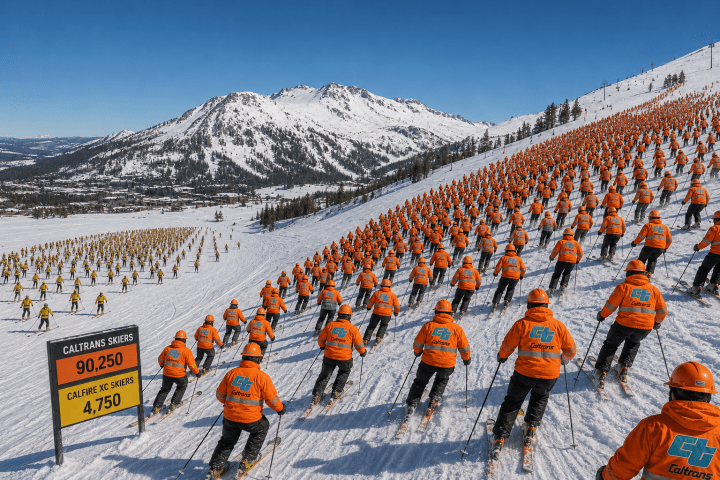
ABOVE: Caltrans and Cal Fire skiers at Mammoth Mountain / ChatGPT
Caltrans Alpine skiers and Cal Fire Nordic skiers represent the proportions of state workers who commute via their own vehicles (Caltrans here) versus state workers who ride public transportation (Cal Fire).
The two groups are used to emphasize the small proportion of workers, about 5 percent, who commute via public transportation in the U.S. (source: U.S. Census Bureau). The number is likely smaller in car-centric California. In practice, of course, workers who suit up like these employees do not usually telework.
The difference between the two groups yields the total number of commuters who would double their carbon emissions, particulate pollution, and time in traffic if Gov. Newsom’s edict is implemented — about 90,250 state workers.
Hence, suggestions that pollution can be mitigated by state-agency incentives for workers to ride public transport are naive.
Another key number is an estimate of the average amount of CO2 generated per commuting motorist, which Medium contributor Geoff Calver estimates at 25.6 lbs. per commute day.
Also contributing to the calculation, the number of state worker commute days under Newsom’s order would rise from the existing 100 to about 200 days per year.
By the numbers:
95,000 – 4,750 (5% of total number) = 90,250 x 25.6 x 100 =
231,040,000 additional pounds of CO2 / year.
If implemented, the governor’s RTO would add more than 231 million additional pounds of CO2 to California’s and the planet’s atmosphere each year.
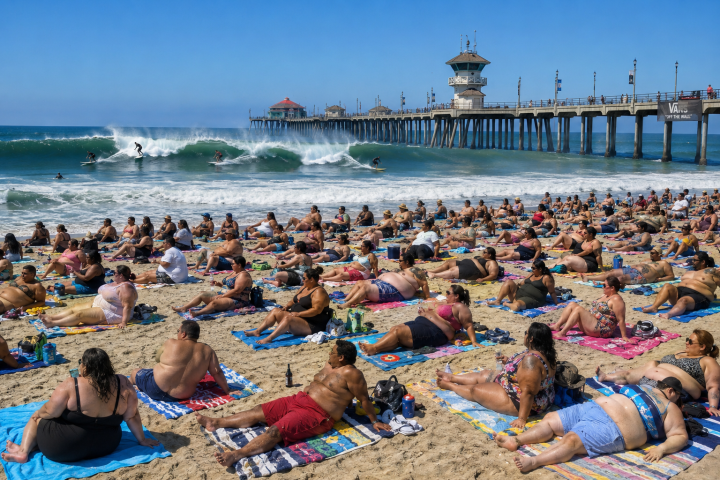
ABOVE: Visitors and surfers at Huntington Beach / ChatGPT
It’s sometimes suggested that California’s growing number of electric vehicles, or EVs, are tamping down CO2 emissions and particulate pollution. But the effect is limited.
To begin with, the materials and construction of an EV produce CO2 and other waste products. Additionally, studies show that EVs release significant toxic tire and brake dust due in part to heavy batteries that increase the strain of braking.
The above image compares the number of state worker commuters who drive internal-combustion vehicles compared to those who drive EVs. According to the U.S. Dept. of Energy, only about 4.1 percent of California “light-duty vehicles” were EVs in 2024.
The proportion is represented above by 100 off-duty state workers lounging on a California beach while just four surfers ride a wave. One surfer is floating — hence 4.1 percent.
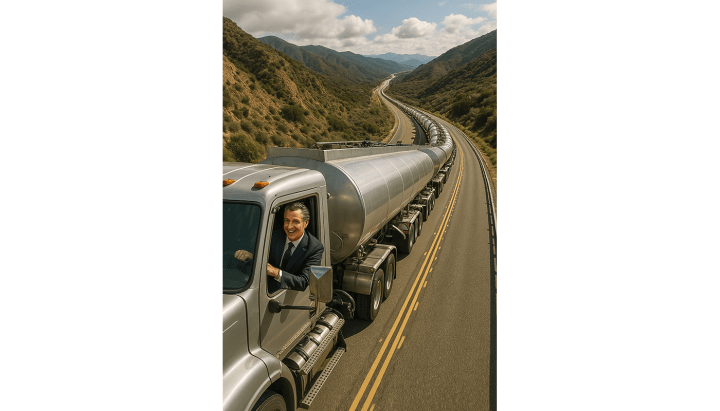
ABOVE: A 17-mile-long tanker truck driven by Gov. Newsom / ChatGPT
How much more gasoline would California state workers need to reach work if Gov. Newsom’s RTO is implemented? The question is an urgent one, with Middle East tensions continuing to pump up gas prices.
The average American vehicle gets 24.9 miles per gallon. The average American commute is 16 miles each way, or 32 miles a day. With this data, we calculate that the average commuter uses 1.28 gallons of fuel each commute day (32 / 24.9 = 1.28).
A few more calculations using numbers outlined above gives us an estimate of the volume of additional gasoline purchased and burned if the governor’s RTO is implemented. The total is 11,700,000 gallons of additional gasoline each year.
One way to visualize this amount is to consider a line of gasoline tanker trucks more than 17 miles long. That’s what Gov. Newsom is driving in the photo illustration above.

ABOVE: Gas-filled swimming pools at Los Angeles’ Exposition Park / ChatGPT
There are other ways to visualize 11,700,000 gallons of gasoline — the amount of additional fuel state workers would need to purchase and burn annually if the governor’s plan were implemented. One is to imagine 17 Olympic swimming pools brimming with gasoline.
Notably, there is one error in the above image. While ChatGPT was asked to produce an image with 17 Olympic swimming pools, it delivered an image with 20 such sized pools.
Perhaps ChatGPT was adding gas to account for an average California commute that is longer than an average American commute.

ABOVE: CO2-filled balloons sitting on the Mojave Desert / ChatGPT
The amount of CO2 a Newsom RTO would generate is of interest — given the governor’s focus on climate across two terms, and in light of the recent CEQA-based legal challenge.
Calculations suggest that burning 11,700,000 of additional gasoline would generate considerable gaseous CO2 — enough, in fact, to fill more than 23,000 hot-air balloons.
A number of those 23,000 hot-air balloons are shown above, spread across a California desert landscape.
Note the balloons aren’t going anywhere. They can’t — as carbon dioxide weighs 1.5 times more per volume than uncontaminated air. And in reality, the balloons wouldn’t be vertically-oriented as they’re depicted here — they’d be flopped over, pressed against the ground.
Erik Skindrud is a writer in Huntington Beach. @Erik_Bookman on X.

