
By Erik Skindrud, InfoWise.org
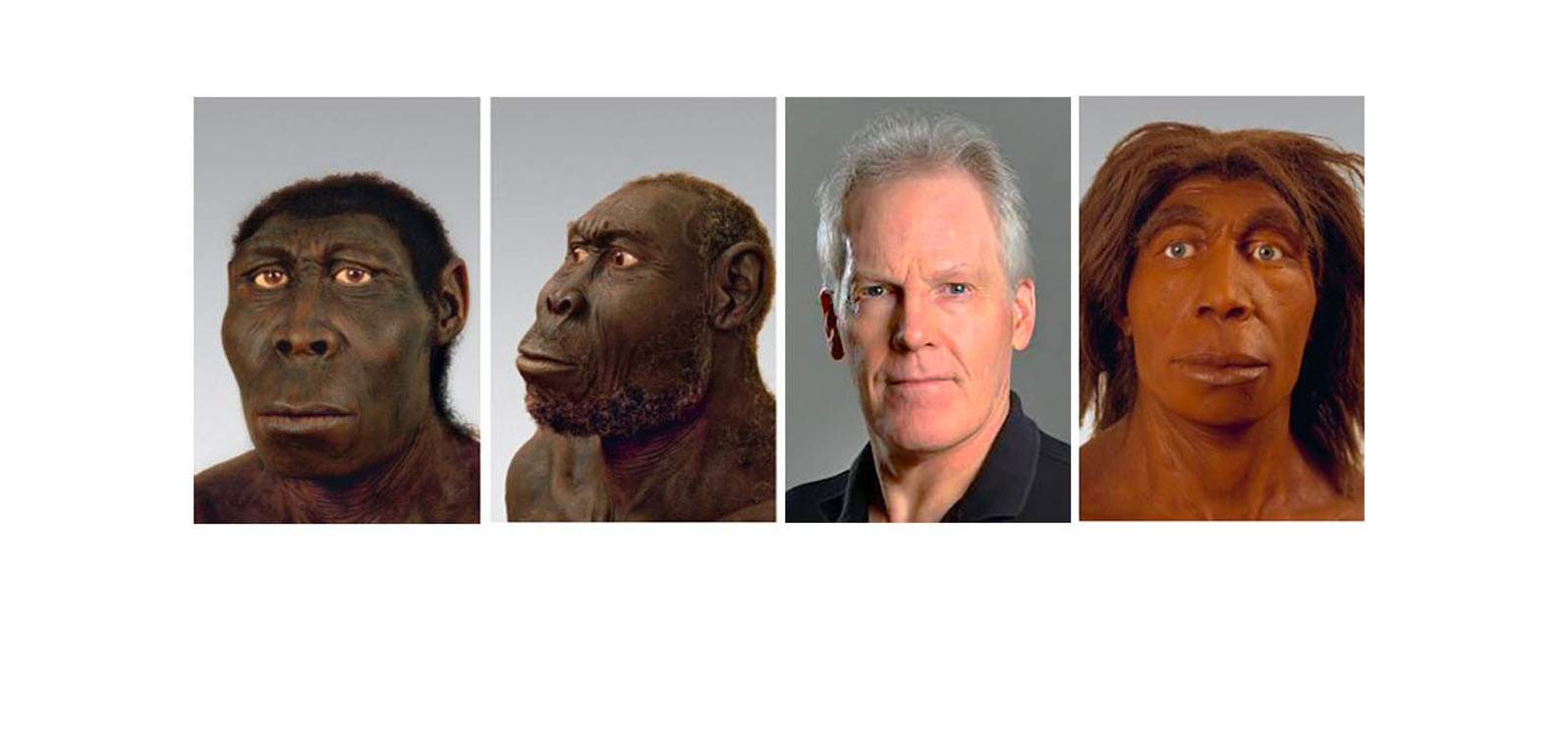
Above: Members of the human family include, from left, homo rudolfensis , homo erectus, neuroscientist Dave Geary, and homo neanderthalensus. Of the species, the Neanderthal enjoyed the largest average brain size. Credits: Visual / Corbis, University of Missouri.
The human brain is shrinking. The amount lost is significant too — the volume of a tennis ball taken from a large cantaloupe.
The surprising conclusion is not taught in high school – but is now widely accepted among experts.
“There’s some debate, but the consensus is that the human brain, on average, is smaller than it was 10,000 years ago – and may have shrunk even more over the last 3,000 years,” paleoanthropologist David C. Geary told InfoWise.org
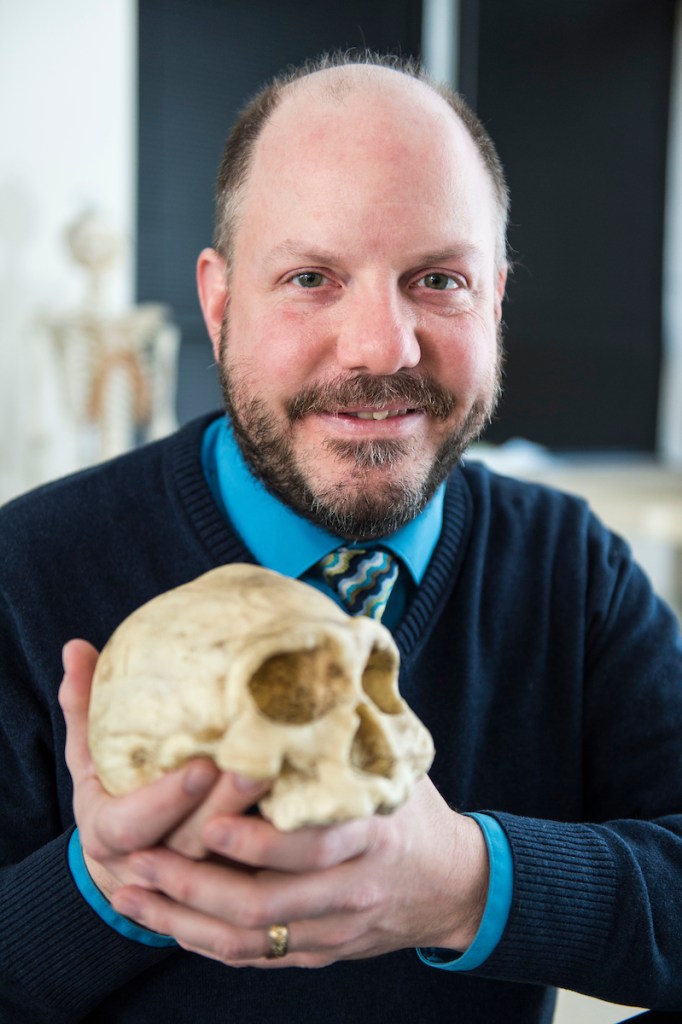
The reasons are debated. One theory points to a vanishing need for individuals to manage their survival in wild and unpredictable environments, Geary, of the University of Missouri, explained.
The scientist put it more simply in another conversation.
“I think the best explanation… Is the ‘Idiocracy’ theory,” he told Discover magazine. “I think something a little bit like that happened to us.”
In the 2006 Mike Judge film, an average guy wakes up 500 years in the future. America has a president who has never read a book. Knowledge of medicine, irrigation, and other basic technology has vanished – plunging the U.S. into cultural decline.
De-evolution is (now) real.” –Devo co-founder Gerald Casale in 2023
It’s a topic that resonates in today’s rapidly-changing and increasingly unstable world.
The lost-brain hypothesis has gained acceptance as evidence has accumulated, said John Hawks of the University of Wisconsin-Madison.
“There is a significant increase over the last decade of scientists supporting the recent reduction in brain size,” he told InfoWise.org.
Hawks today, however, is “much less confident in the pattern of (brain size) change over the last 10,000 years,” he said. More precise measurement of skulls in museum collections is needed to confirm this trend took place across the globe – as other researchers believe.
While the so-called Idiocracy theory suggests we’re getting dumber, the opposite may be true. The loss of gray matter, in fact, may coincide with new language and “symbolic information processing” abilities that appeared over the last 100,000 years, paleoanthropologist Ian Tattersall of the American Natural History Museum in New York, suggests.
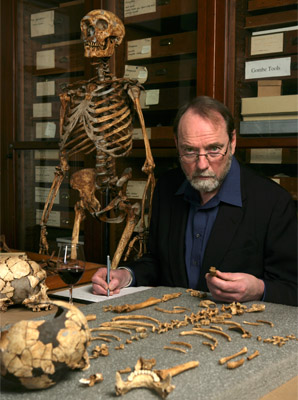
Credit: http://www.iantattersall.com
New abilities and circuitry have made the brain more efficient, reducing its need for volume, the thinking goes.
Cognitive scientist Jeff Morgan Stibel, on the other hand, believes the trend is more recent. In a 2023 study, he compared 300 human skulls from the last 50,000 years. His results point to a decline in our gray matter starting 17,000 years ago – around the end of the most recent ice ages.
This may suggest an unpleasant arc for human intelligence as the planet warms further.
“The most important thing to understand is that the human brain continues to evolve,” Stibel told the publication PsyPost. “The Holocene warming period has led to more than a 10 percent reduction in brain size in modern humans. If global temperatures continue to warm, this could place increased evolutionary pressure on the human brain.”
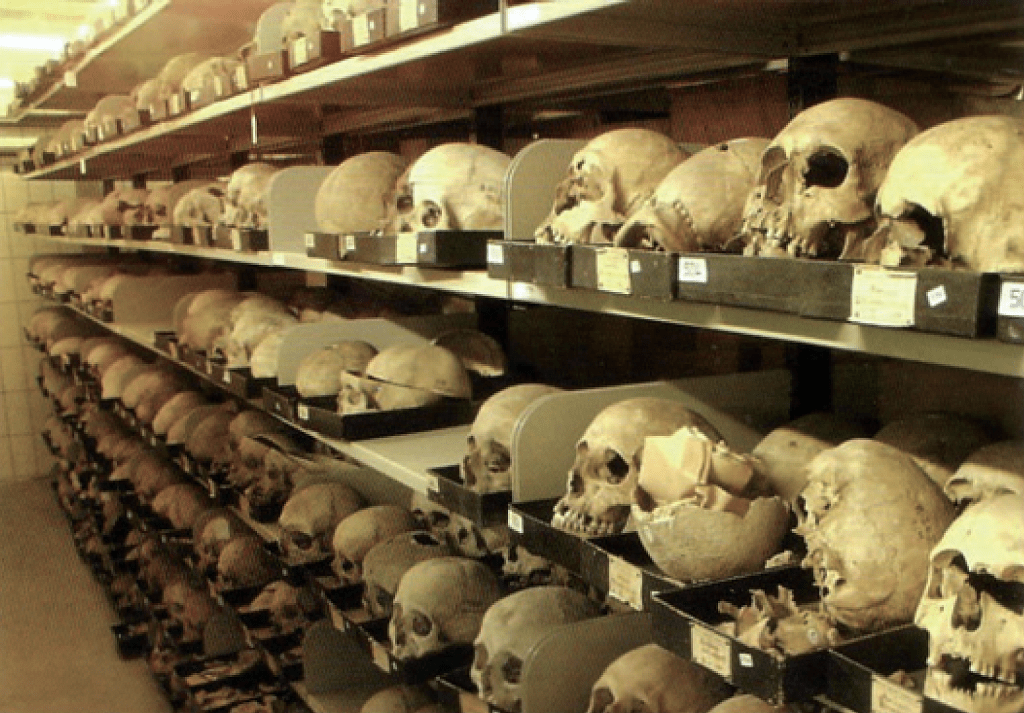
The Alexander Ecker Collection in Freiburg, Germany is one of the largest collections of fossil skulls in Europe. The photo was taken several decades ago — remains are now stored in individual containers. Credit: The Alexander Ecker Collection
Stibel is a board member and trustee of the Natural History Museum in Los Angeles.
This is sobering conclusion as planetary climate change seems to kick into a higher gear.
University of Wisconsin’s Hawks comes across as a cautious figure, not tempted by the bait these juxtapositions seem to offer.
“This is a very deep topic and my thoughts are a bit complicated,” he told me.
A 2015 PBS documentary presents Hawks and his surprising finding. It was eye-opening then, and my sense of wonder at the nuances of evolution has only continued to grow.
Titled “First Peoples, Episode 1: The Ancient Tribes That Settled the Americas,” the show is viewable via YouTube here.
Hawks’ statement on brain size starts around minute 51.
The narrator, helpfully, shares a straightforward summary of our apparent dumbification.
“Living in cities, our brains aren’t having to work so hard,” he related. “We (now) rely on the intelligence of others.”
It’s tempting to expand on this logic. Along these lines, the internet, computers, and so-called “artificial intelligence” might be expected to further starve our thinking organ.
The idea that the internet, social media and related technology might further shrink the brain is pure speculation, of course — not yet a testable hypothesis.
Warming-driven scarcity in our future, along with political strife, might present humans with new problems to solve — sparking a rebound in brain growth.
It’s important to keep the distinction between genetic evolution and changing habits of thought in mind — as the lines between them persistently blur in popular culture.
The adverse effects of technology on human psychology are a widely-discussed topic. Examples include Nicholas Carr’s “The Shallows: What the Internet Is Doing to Our Brains” (2010), and Jean Twenge’s “iGen: Why Today’s Super-Connected Kids Are Growing Up Less Rebellious, More Tolerant, Less Happy — and Completely Unprepared for Adulthood — and What That Means for the Rest of Us” (2017).
Devo – the quirky rock act from Ohio, took its name from ‘de-evolution’ – a genetic concept much less developed in the 1970s than now.

Devo co-founder Gerald Casale recently shared his surprise that the ideas of “smartass college guy(s) being clever” have survived the test of time, he told the New York Times in 2023.
Devo playfully blurred the lines between culture and genetic science. The band saw “American culture evolving in the wrong directions, or devolving: dumbing down, losing individuality, succumbing to corporate imperatives and treating people as machines while anesthetizing itself with consumption.”
“We were noticing an exponential increase in a certain kind of dysfunction going on. And we labeled it,” Casale said.
“I didn’t really think that we’d go where we went, because de-evolution is (now) real,” he told the paper.
With comments or corrections, please email eskindrud@gmail.com.
 InfoWise.org