

Above: Director Welles (center) faces actor Joseph Cotton on winter-themed set inside a Los Angeles frozen storage facility for “The Magnificent Ambersons” in late 1941 or early 1942. Cinematographer Stanley Cortez is behind camera. Provided caption identifies location as “Ice and Cold Storage company in Los Angeles.” Photo: RKO archive / Alamy.
By Erik Skindrud, InfoWise.org
Lost in arguments over Los Angeles’ Cold Storage / Fourth & Central redevelopment plan is a fascinating footnote — a historic structure at the project’s center likely served as a location for Orson Welles 1942 film “The Magnificent Ambersons.”
“The Magnificent Ambersons” can be viewed free (with ads) on the Plex streaming service.
Lesser-known than “Citizen Kane,” ‘Ambersons’ is revered by scholars and film buffs. Today, interest remains high enough to fuel a soon-to-be released documentary, and a project that will employ artificial intelligence to reconstruct its missing 53 minutes.
The City of Los Angeles Planning Commission holds a public hearing on the Fourth & Central project at 8:30 a.m. on Thursday, Oct. 9. Location is Los Angeles City Hall, 200 North Spring St., Los Angeles CA 90012. View the meeting agenda here.
Planned for the industrial zone south of Little Tokyo (and Skid Row), the Fourth & Central development will encompass 7.5 acres and add at least nine new structures — including one of 30 stories. The planning team — along with California Gov. Gavin Newsom — trumpet it as a remedy to the region’s housing storage. The Little Tokyo community, on the other hand, see it as gentrification that will degrade the community’s unique character.
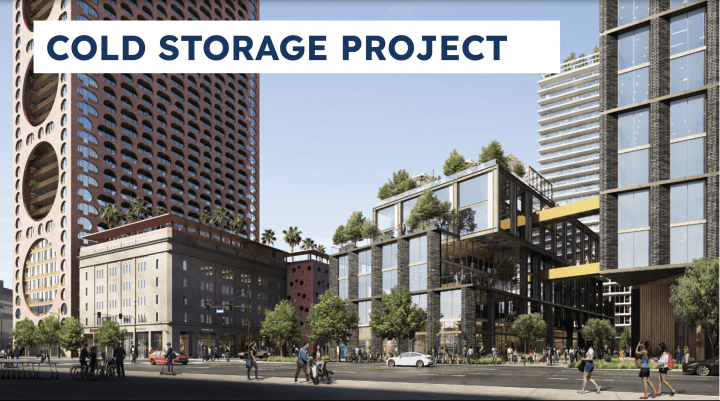
Above: A project rendering displays the existing Cold Storage building reused as a commercial structure. Image via Little Tokyo Community Council
At the project’s center sits a six-story cube — painted white to reflect solar radiation and topped by wind socks to chart the direction of ammonia leaks. Marked with faux windows, it was designed around 1903 by architect George Wyman — known for the Bradbury Building at 3rd and Broadway.
Planners designate the Cold Storage building for ‘adaptive reuse’ — a term that often oversells the portion preserved. In this case, results of the defrosting process will determine the building’s fate. Interestingly, the building has likely been uninterruptedly frozen for more than a century. If structural weakness follows the thawing process, the wrecking ball will likely step in.
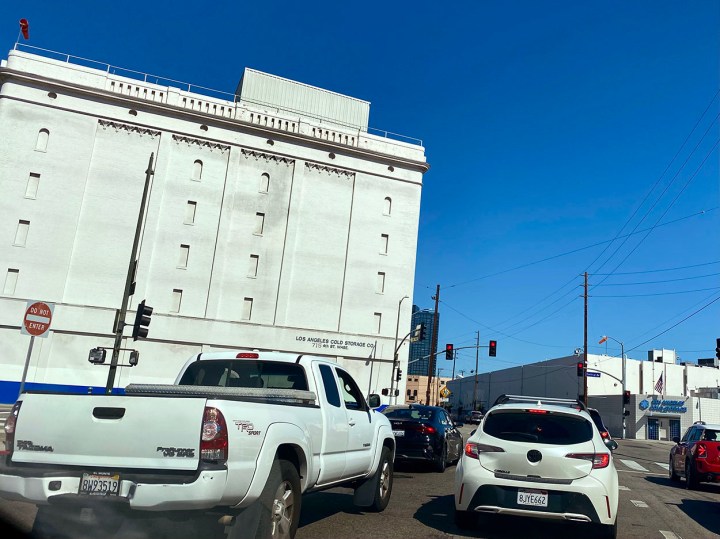
Above: The 1903 Los Angeles Cold Storage Company building has been uninterruptedly frozen for more than a century, a report by the Los Angeles Conservancy notes. The structure is seen from traffic at Fourth Street and Central Avenue. Photo: Erik Skindrud
That the Fourth and Central Cold Storage building was used for the famous Ambersons “snow scene” is incompletely documented by notes, articles and photographs. The weight of evidence suggests it’s the place, however.

Above: The project development team acknowledges that the Cold Storage building provided a winter location for multiple films. Image: Fourth & Central project team
IMDB lists the Ice & Cold Storage Company as the scene’s location. The American Society of Cinematographers site recalls it as “the big ice plant in downtown Los Angeles, where Columbia had filmed much of ‘Lost Horizon‘ and ‘The Man With Nine Lives.'”
The American Film Institute entry includes the following statement. “The snow sequence was filmed at the Union Ice Company ice house in downtown Los Angeles,” it asserts. There doesn’t seem to be a record of a Union Ice facility in downtown L.A., however.
Then there’s film writer and documentarian Mark Cousins, whose 2018 “The Eyes of Orson Welles” places the ice plant downtown — but at 6th and San Pedro streets.
Cousins lives in Edinburgh, but knows Los Angeles. Perhaps he’s correct.
According to the Los Angeles Conservancy, however, an ice house never sat at the corner.
“I don’t believe there was ever an ice plant or cold storage facility on that site,” Andrew Salimian, the conservancy’s director of advocacy, said via email.
“In 1935, a permit for a gas station was issued and you can see the gas station in an Sanborn Map dating to 1950,” Salimian noted.

Above: From Library of America entry on “The Magnificent Ambersons.”
“Only in a studio could such an idealized scene be shot,” Cousins reverently remarks in his 2018 film — delivering an imaginary letter to Welles. “And that’s what you used — the biggest ice box in Los Angeles.”
“It was on this corner (6th Street and San Pedro Avenue) But it’s gone now,” he says.
Cousins may not get the address right, but he nails the big picture.
“This part of downtown L.A. is now one of the most deprived in the U.S.,” he states. “Paradises — don’t last.”
Maybe it makes sense that the location is hard to pin down. Time magazine called ‘Ambersons’ “adult and demanding” in a 1942 review. The film explores the cultural transformation wrought by the automobile — and its accompanying death toll. Others delve deeper. ‘Ambersons’ charts “the demise of its European-style gentry and their socioeconomic replacement by an industrial and distinctively American ‘big’ bourgeoisie,” British director David Alexander has opined.
The “snow scene” — shot somewhere in Los Angeles — glances nostalgically back at an America just meeting the motorcar. In the scene, the technology is sputtering and non-threatening.
“Men’s minds are going to be changed in subtle ways because of automobiles,” the character played by Robert Cotton declares toward the film’s end.
It would certainly be the case. ‘Ambersons’ provokes on many levels, and is worth reexamining.
Erik Skindrud is a writer in Long Beach, Calif. @Erik_Bookman on X. If you know of material that precisely documents the location of the ‘Ambersons’ snow scene shoot, please share via eskindrud(at)gmail.com.
 InfoWise.org