

The Swedish submarine HSMS Gotland (foreground above) sank the USS Ronald Reagan in exercises off San Diego in 2005. The $4.5 billion aircraft carrier (background) is the most expensive weapons system in the world, according to Guinness World Records. Photo: U.S. Navy Photographer’s Mate 1st Class Michael Moriatis
By Erik Skindrud, InfoWise.org
A military documentary — domain of middle-aged, male nerds — may not be your usual source for case studies on women in the workplace. That’s where “Sea Power,” released in German in 2020, exceeds expectations.
Now offered in English by Netflix, the series summarizes naval hardware and strategy from the late 19th century to a 2005 encounter between a nuclear-powered aircraft carrier and a sub crewed by 35 women and men.
How the Swedish submarine eluded detection is a technical tale — told in Popular Mechanics, Forbes, Business Insider and other media. Briefly, the craft operates using a super-quiet Stirling air-independent propulsion (AIP) system. The result: it snuck up on and “torpedoed” the Reagan multiple times during war games off San Diego.
“This outcome was replicated time and time again over two years of war games, with opposing destroyers and nuclear attack submarines succumbing to the stealthy Swedish sub,” journalist Sébastien Roblin wrote.
Less discussed is the role Scandinavian egalitarianism and gender equity may have played in the contest.
Sweden tops the Glass-Ceiling Index (GCI) published annually by the conservative U.K.-based Economist. In 2022, the U.S. sat at position 20 — just behind Ireland. The index is a ranking of developed countries where women have the best — and worst — odds of fair and equal treatment at work.

The series’ high note is an interview with Paula Wallenburg — the executive officer who maneuvered the vessel and “fired” torpedoes during the 2005 exercise. Wallenburg can’t disguise a trace of relish in relating her role.
“On Dec. 6, 2005, Gotland, the Reagan and their escort ships leave San Diego,” Sea Power’s narrator begins. “What happens next remains top secret to this day.
“Gotland sneaks past one U.S. warship after another. She penetrates all of the Ronald Reagan’s protective shields. As proof, she takes photos of the carrier’s hull. In wartime, she would have fired torpedoes instead — and sunk the $6.2 billion aircraft carrier.”
(Sea Power’s estimate for Ronald Reagan’s total cost exceeds Guinness World Records’. The Gotland-Reagan encounter is related in the series’ episode 4.)
“The successful maneuver is primarily Paula Wallenburg’s achievement — even if she is not allowed to reveal exactly how she did it.”
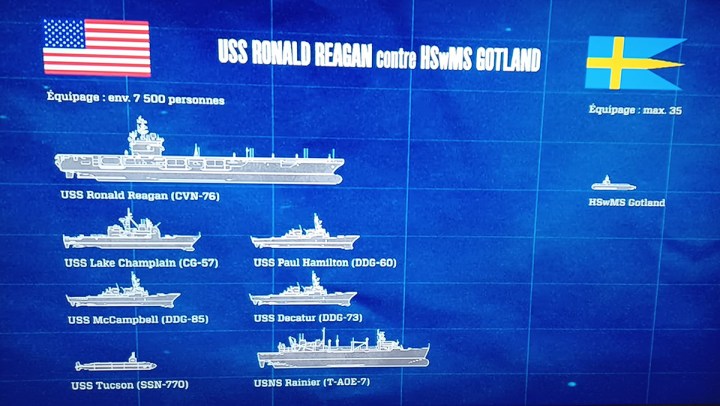
She may be sworn to secrecy, but the Swedes did spill the beans on a number of cultural disconnects in a 2008 article by its armed forces.
“Female crew members are nothing strange on a Swedish submarine,” the 2008 report notes. “A woman crew member works under the same conditions as her male counterparts. In contrast, women are never to be found serving on American submarines. (U.S. commanders) have an entirely different attitude toward female crew.”
Some were even “overtly hostile” to the notion.
“Things got better as time went on,” Wallenburg recalled later. “They usually do, as long as you have an open and giving attitude.”
The Norwegian Navy, in 1985, was the world’s first to place women on submarines.
Wallenburg was assigned a three-person cabin while serving as observer on one U.S. vessel. She shrugged, telling her hosts the gesture was unnecessary.
American observers on Gotland were astonished at the level of responsibility Sweden hands to crew, Wallenburg recalled.
“We allow a significantly greater degree of responsibility to rest in the hands of individual personnel,” she noted. “For us this is a natural way of doing things, while the Americans take a more restricted view of their respective tasks onboard.
“There is nothing wrong with that, it’s just a different way of approaching matters,” she said — perhaps with a touch of diplomacy.
In the end, the operation proved “a feather in the cap” for the Swedish military — and its women and men — Rear Admiral Bertil Björkman summed up. “Few realize what outstanding PR this has been,” he said in 2008.
Writing later, the U.S. Naval Institute’s Norman Polmar said the Gotland “ran rings” around Ronald Reagan and its escort ships.
Journalist Roblin quoted another unnamed source, who said U.S. antisubmarine specialists were “demoralized” by the 2005 experience
It must have been tough on those guys — sunk by a woman.
 InfoWise.org