
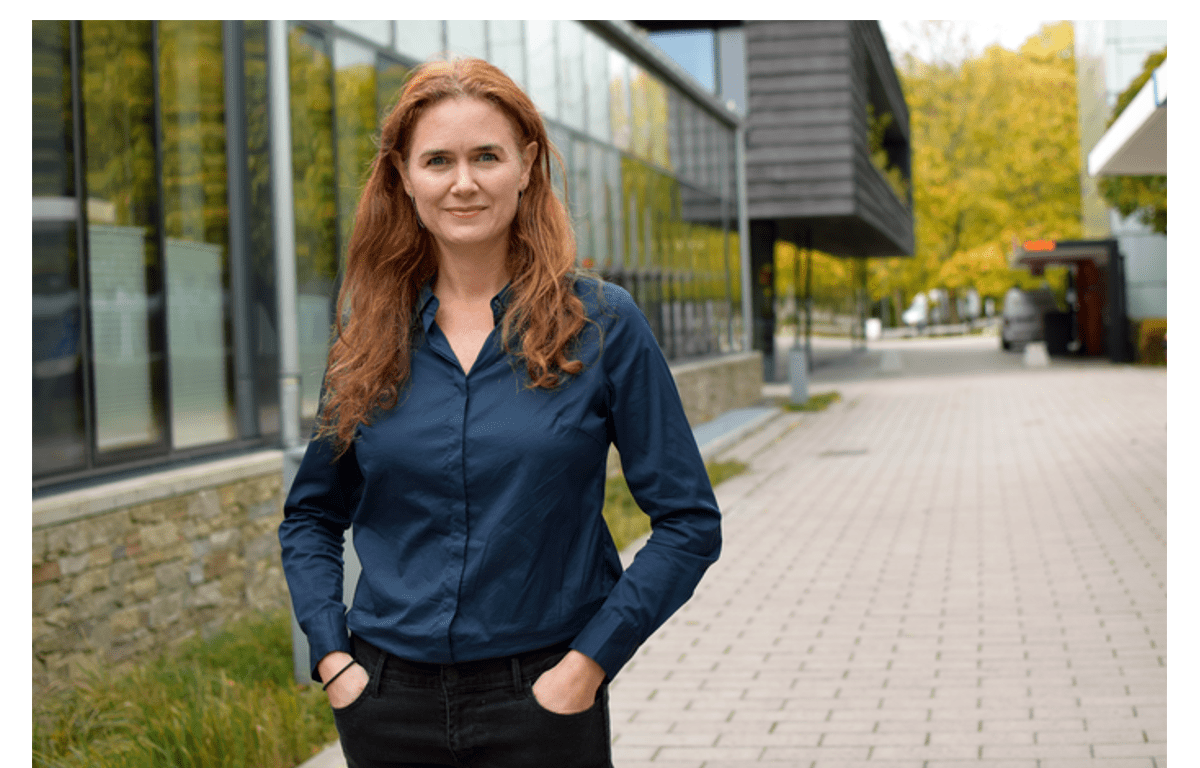
University of Stockholm researcher Sunnee Billingsley (above) led a population-level study that showed how in-person work elevates COVID-19 mortality risk for one vulnerable group. Photo: Elin Sahlin/Stockholm University.
By Erik Skindrud, InfoWise.org
What risks do in-office employment present during the COVID-19 era? The question is encumbered with political, social, economic and other baggage.
A growing number of papers published in peer-reviewed journals are taking the issue on, however, and they’re uncovering some surprises.
Crunching numbers from the entire country of Sweden, a nation of more than 10 million people, yielded one standout finding for Sunnee Billingsley, PhD, a demographer and sociologist at Stockholm University.
Researchers found that elderly Swedes living with working-age family members not granted remote-work privileges died at consistently higher rates — irrespective of families’ socioeconomic status. The paper appeared in the January 2022 issue of the Scandinavian Journal of Work, Environment & Health.
“Even if the elderly changed their routines to protect themselves during the pandemic, they were put at risk by workers living in their homes,” Billingsley told InfoWise.org.
“Working from home (for all employees in jobs suitable for remote work) could play an important role in lowering this risk for them,” Billingsley added.
The Swedish data deserves wider consideration as the debate over in-office versus remote work continues — and as COVID-19 numbers trend up yet again — across the U.S.
In Los Angeles County, the number of COVID “worksite clusters” has rocketed skyward over the past six weeks. If the trend continues, the nation’s largest county will enter the CDC’s “high,” or most severe, designation on its COVID-19 Community Level Matrix — triggering widespread indoor masking mandates and increasing pressure on employers to reinstate emergency remote-work arrangements.
For the below graph, worksites include retail, dining and office settings. Clusters during the May 4 through 10 period, for example, were recorded in building material and garden equipment stores, in bars and restaurants, in electronic and appliance stores, and in offices dedicated to manufacturing, finance and insurance.
Los Angeles County worksite cluster numbers are updated each Tuesday and Thursday afternoon here.
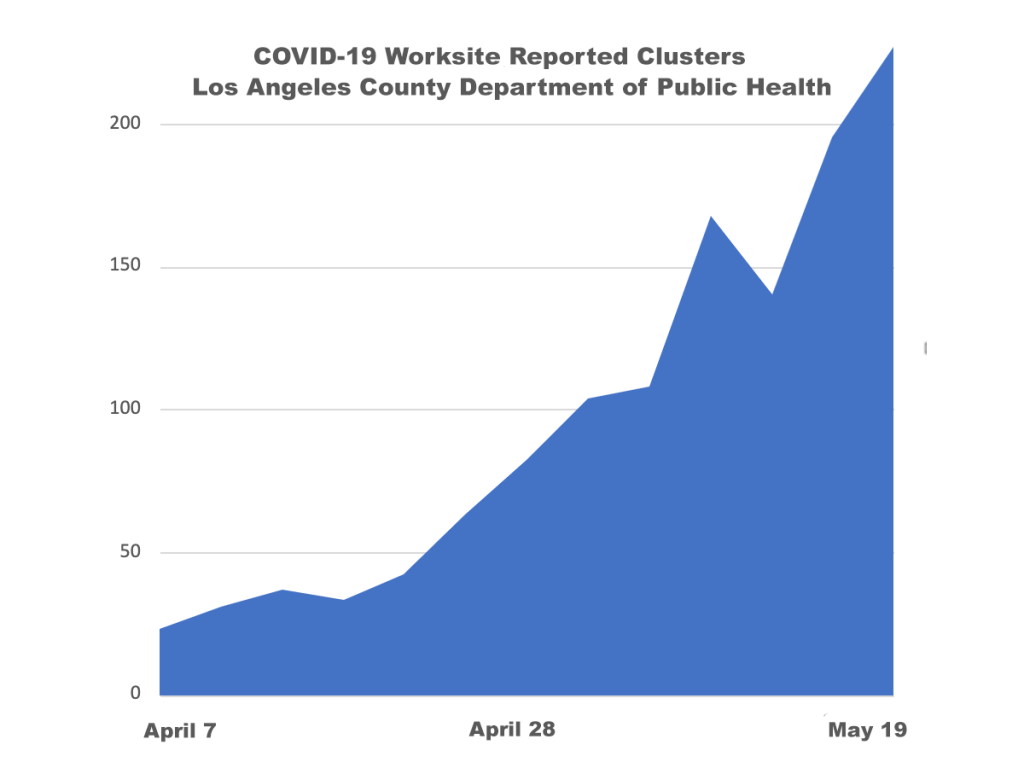
L.A. County Dept. of Public Health.
One thing about office COVID transmission that’s well understood is how it occurs. Scientists have exhaustively charted how inhalation of respiratory droplets carries the SARS-CoV-2 virus from person to person.
The same principle holds for the influenza virus — which claimed between 50 and 100 million lives in the pandemic of 1918-20.
Writing in the Journal of Public Economics in 2021, University of Arkansas researcher Dongya “Don” Koh and colleagues calculated that working people are 35.3 percent more likely to be infected with flu than retired, unemployed or other individuals. The team also found that face-to-face contact at work is positively associated with increased chance of infection.
“These results shouldn’t surprise anyone,” Koh said. “We hope they are relevant for an understanding of the spread of flu and other infectious diseases transmitted via respiratory droplets or close human contact, including SARS and COVID.
“We think these results provide a basis for an organizational policy that both protects workers and optimizes production and efficiency,” he added.
The study is based on data from the Medical Expenditure Panel Survey, which collects comprehensive health care cost information related to U.S. families and individuals, employers and medical providers.
As COVID numbers trend up, scientists are making discoveries that are revising ideas about office safety. Published in this month’s Journal of Aerosol Science, a team led by Yidan Shang of Shanghai University finds new variants are capable of leapfrogging the three-to-six feet usually suggested for distancing.
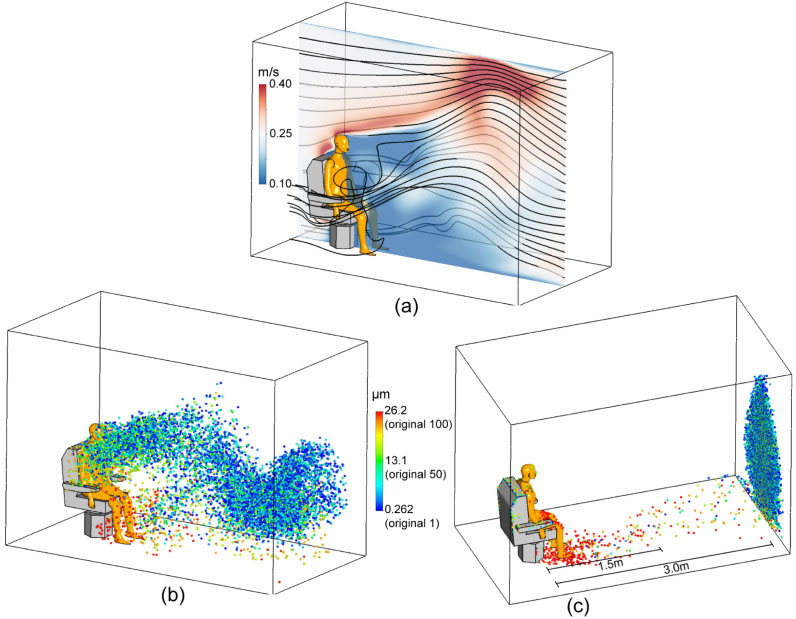
Shang’s team introduced airflow into the equation and were surprised to find that even three meters (or nine feet) is “insufficient to contain the spread of the Delta variant.”
“To safely reopen the office before reaching the comprehensive (world) COVID-19 vaccination (possible in 2024), the social distance rule applied in the indoor environment needs to be carefully evaluated,” the paper concludes.
The question of office safety in the COVID era remains a charged issue — more commonly tackled in op-eds than news pieces. For that reason, regular checks of science databases like EurekAlert! and PubMed will likely remain priorities for concerned readers for some time to come.
 InfoWise.org